OpenFlights Analysis with grafeoR
Source:vignettes/openflights-analysis.Rmd
openflights-analysis.RmdThe package ships with a compact real-world OpenFlights subset so you can test the Rust binding against graph data that looks like an actual transport network, not just toy nodes and edges.
The bundled sample contains:
- the 20 airports with the highest outbound route counts in the upstream OpenFlights snapshot
- the 1,129 airline route records whose source and destination are both inside that 20-airport subset
sample <- openflights_sample_data()

dim(sample$airports)
#> [1] 20  7
dim(sample$routes)
#> [1] 1129    5
head(sample$airports[, c("iata", "city", "country", "snapshot_outbound_routes")])
#>   iata      city        country snapshot_outbound_routes
#> 1  ATL   Atlanta  United States                      915
#> 2  ORD   Chicago  United States                      558
#> 3  PEK   Beijing          China                      535
#> 4  LHR    London United Kingdom                      527
#> 5  CDG     Paris         France                      524
#> 6  FRA Frankfurt        Germany                      497
head(sample$routes)
#>   airline source_iata dest_iata stops equipment
#> 1      DL         AMS       ATL     0   333 76W
#> 2      KL         AMS       ATL     0       777
#> 3      HV         AMS       BCN     0   73H 73W
#> 4      IB         AMS       BCN     0       320
#> 5      KL         AMS       BCN     0       737
#> 6      MU         AMS       BCN     0       737
Load the graph into Grafeo
load_openflights_graph <- function(db, sample) {
  airports <- sample$airports
  airports$lat <- airports$latitude
  airports$lng <- airports$longitude
  airports$latitude <- NULL
  airports$longitude <- NULL
  nodes <- db$import_nodes(airports, labels = "Airport", id_col = "iata")

  routes <- sample$routes
  node_ids <- setNames(nodes$ids, nodes$keys)
  routes$source_id <- unname(node_ids[as.character(routes$source_iata)])
  routes$target_id <- unname(node_ids[as.character(routes$dest_iata)])
  db$import_edges(routes, "source_id", "target_id", "ROUTE")
  invisible(db)
}
db <- grafeo_db()

load_openflights_graph(db, sample)
db$info()
#> $graph_model
#> [1] "LPG"
#>
#> $node_count
#> [1] "20"
#>
#> $edge_count
#> [1] "1129"
#>
#> $is_persistent
#> [1] FALSE
#>
#> $path
#> NULL
#>
#> $wal_enabled
#> [1] FALSE
#>
#> $read_only
#> [1] FALSE
#>
#> $version
#> [1] "0.5.42"
#>
#> $current_graph
#> NULL
Query airport and route data back into R
For the charts below, grafeoR is used to pull nodes and
edges back into R as data frames, and the aggregation for plotting is
handled on the R side.
airports_tbl <- db$query(
  paste(
    "MATCH (a:Airport)",
    "RETURN a.iata, a.name, a.city, a.country, a.lat, a.lng,",
    "a.snapshot_outbound_routes",
    "ORDER BY a.snapshot_outbound_routes DESC, a.iata"
  )
)

routes_tbl <- db$query(
  paste(
    "MATCH (src:Airport)-[r:ROUTE]->(dst:Airport)",
    "RETURN src.iata, src.lat, src.lng, dst.iata, dst.lat, dst.lng, r.airline"
  )
)

route_segments <- aggregate(
  routes_tbl$r.airline,
  by = list(
    source_iata = routes_tbl$src.iata,
    source_lat = routes_tbl$src.lat,
    source_lng = routes_tbl$src.lng,
    dest_iata = routes_tbl$dst.iata,
    dest_lat = routes_tbl$dst.lat,
    dest_lng = routes_tbl$dst.lng
  ),
  FUN = length
)
names(route_segments)[names(route_segments) == "x"] <- "airline_count"
route_segments <- route_segments[
  order(
    -route_segments$airline_count,
    route_segments$source_iata,
    route_segments$dest_iata
  ),
  ,
]

head(airports_tbl[, c("a.iata", "a.city", "a.country", "a.snapshot_outbound_routes")])
#>   a.iata    a.city      a.country a.snapshot_outbound_routes
#> 1    ATL   Atlanta  United States                        915
#> 2    ORD   Chicago  United States                        558
#> 3    PEK   Beijing          China                        535
#> 4    LHR    London United Kingdom                        527
#> 5    CDG     Paris         France                        524
#> 6    FRA Frankfurt        Germany                        497
head(route_segments)
#>    source_iata source_lat source_lng dest_iata dest_lat   dest_lng
#> 55         ORD    41.9786 -87.904800       ATL  33.6367 -84.428101
#> 40         ATL    33.6367 -84.428101       ORD  41.9786 -87.904800
#> 69         ATL    33.6367 -84.428101       MIA  25.7932 -80.290604
#> 98         JFK    40.6398 -73.778900       LHR  51.4706  -0.461941
#> 81         LHR    51.4706  -0.461941       JFK  40.6398 -73.778900
#> 56         MIA    25.7932 -80.290604       ATL  33.6367 -84.428101
#>    airline_count
#> 55            20
#> 40            19
#> 69            12
#> 98            12
#> 81            12
#> 56            12
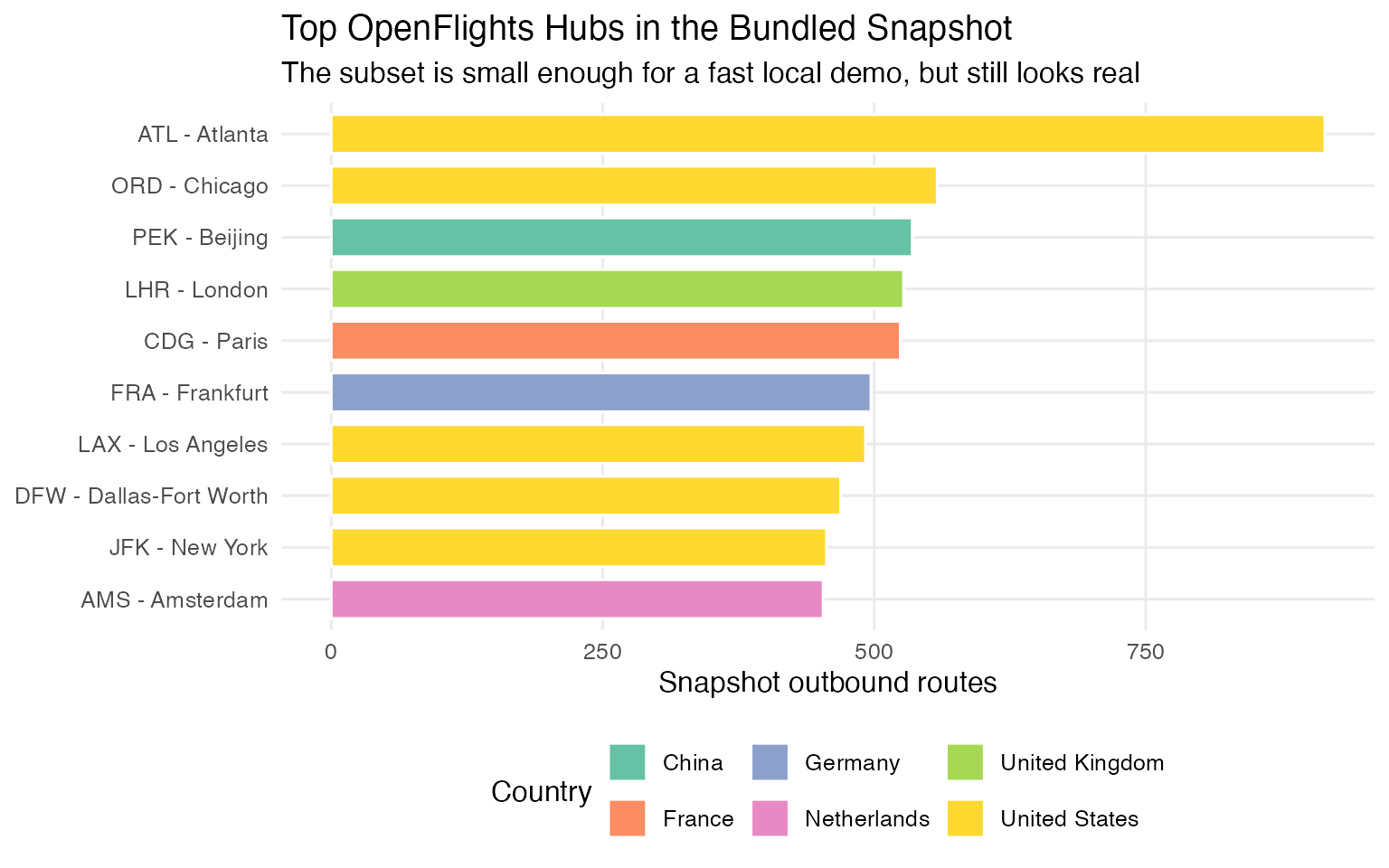
Visualize the hubs
top_hubs <- airports_tbl[seq_len(min(10L, nrow(airports_tbl))), , drop = FALSE]
top_hubs$airport <- factor(
  paste(top_hubs$a.iata, top_hubs$a.city, sep = " - "),
  levels = rev(paste(top_hubs$a.iata, top_hubs$a.city, sep = " - "))
)

ggplot(
  top_hubs,
  aes(
    x = airport,
    y = a.snapshot_outbound_routes,
    fill = a.country
  )
) +
  geom_col(width = 0.75, color = "white") +
  coord_flip() +
  scale_fill_brewer(palette = "Set2") +
  labs(
    title = "Top OpenFlights Hubs in the Bundled Snapshot",
    subtitle = "The subset is small enough for a fast local demo, but still looks real",
    x = NULL,
    y = "Snapshot outbound routes",
    fill = "Country"
  ) +
  theme_minimal(base_size = 12) +
  theme(
    panel.grid.minor = element_blank(),
    legend.position = "bottom"
  )
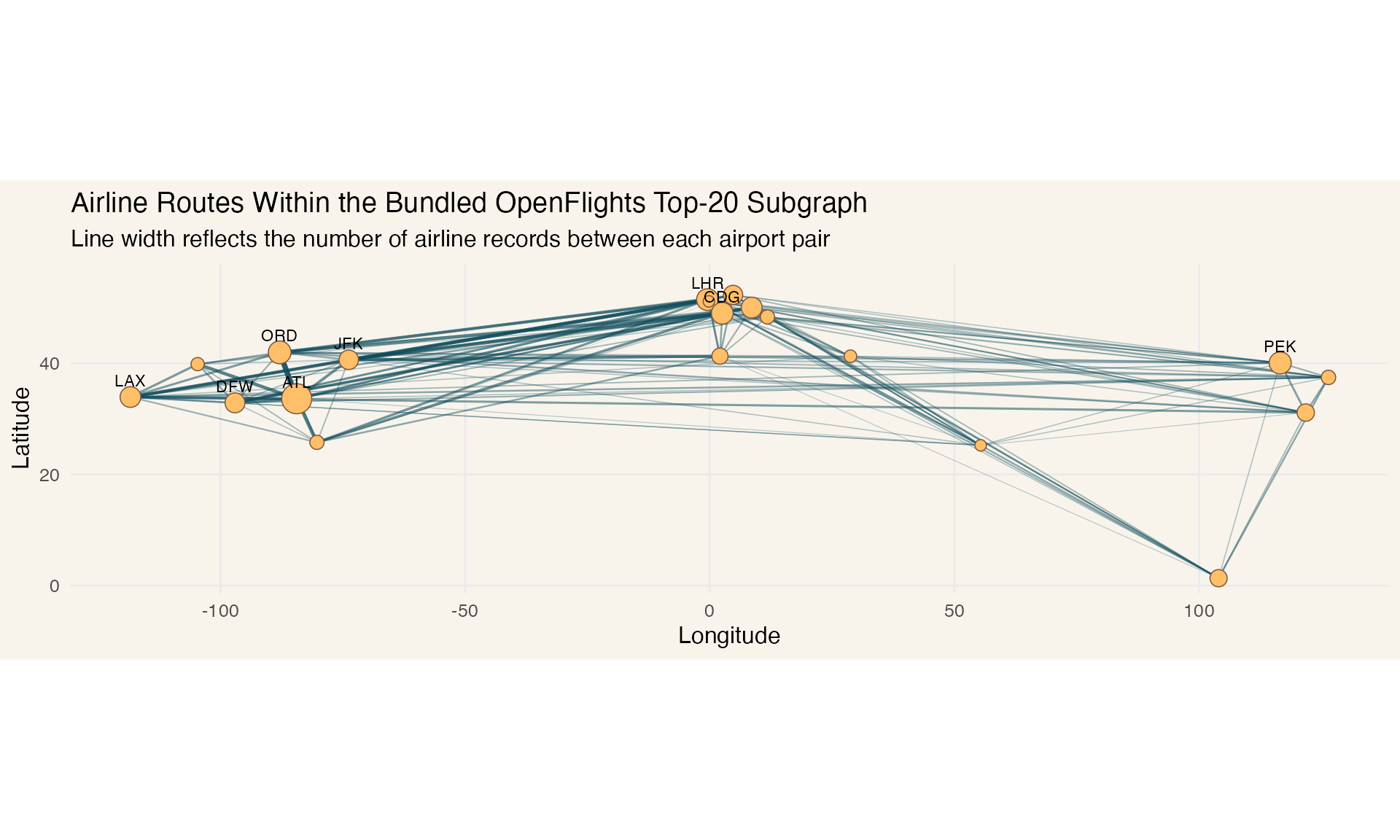
Visualize the route network
labels <- airports_tbl[seq_len(min(10L, nrow(airports_tbl))), , drop = FALSE]

ggplot() +
  geom_segment(
    data = route_segments,
    aes(
      x = source_lng,
      y = source_lat,
      xend = dest_lng,
      yend = dest_lat,
      linewidth = airline_count,
      alpha = airline_count
    ),
    color = "#0f4c5c",
    lineend = "round"
  ) +
  geom_point(
    data = airports_tbl,
    aes(
      x = a.lng,
      y = a.lat,
      size = a.snapshot_outbound_routes
    ),
    shape = 21,
    fill = "#ffbf69",
    color = "#7f5539",
    stroke = 0.4
  ) +
  geom_text(
    data = labels,
    aes(
      x = a.lng,
      y = a.lat,
      label = a.iata
    ),
    size = 3,
    nudge_y = 3,
    check_overlap = TRUE
  ) +
  coord_quickmap() +
  scale_linewidth(range = c(0.2, 1.3), guide = "none") +
  scale_alpha(range = c(0.15, 0.7), guide = "none") +
  scale_size(range = c(2.5, 7), guide = "none") +
  labs(
    title = "Airline Routes Within the Bundled OpenFlights Top-20 Subgraph",
    subtitle = "Line width reflects the number of airline records between each airport pair",
    x = "Longitude",
    y = "Latitude"
  ) +
  theme_minimal(base_size = 12) +
  theme(
    panel.grid.minor = element_blank(),
    plot.background = element_rect(fill = "#f8f4ec", color = NA),
    panel.background = element_rect(fill = "#f8f4ec", color = NA)
  )
The bundled sample is documented in
inst/extdata/openflights-README.md, including the upstream
source URLs and license attribution to OpenFlights.